So you read the last one. You bought in, you aimed for zero, and about three days in your body turned on you. Cravings. Your gut yelling at you all day. And then the headaches — the real ones, the kind that make you eye a bagel just to make them stop. You hate it. And if you've cut carbs before, you already know this part, because it's exactly where you quit last time.
I've heard it a hundred times. "Yeah, I can't do that, I get headaches, it's not sustainable, it doesn't work." And I tell them all the same thing: you didn't do it wrong. You were just missing one piece nobody handed you.
Here it is. The moment you cut carbs, your body starts dumping salt. You literally pee it out — when your carbs and your insulin drop, your kidneys get the signal to let sodium go, and it goes.
You've heard people wave off that first week or two of low-carb weight loss as "just water weight." They're right — you did lose water. But here's what they leave out: the water leaves with the salt, and if you don't put the salt back, your brain ends up dehydrated and low on sodium, and that — not some desperate craving for bread — is your headache.
So put the salt back. Not a lot. Some. Salt your food more than you're used to, eat salty things. For me that's bacon and eggs — protein, fat, no carbs, plenty of salt, and I actually like it.
That's the stitch: the pain that makes people quit isn't your body begging for carbs. It's salt and water.
So how much salt? Here's what I actually do. One of those zero-sugar drink crystals — Gatorade Zero, Crystal Light, whatever — into about 16 ounces of water, and a quarter teaspoon of salt. Shake it. The quarter teaspoon doesn't wreck the flavor and I drink it because I like it. One. Not three in a row — three in a row and, trust me, your bowels will have opinions. One a day plus salting your food, and you're covered.
Now — if you're not a salt person, or you've been told your whole life salt is the devil, or your doctor has you on a low-sodium anything: stop and ask them first. I mean it. I'm some guy on the internet with a string trimmer, not your cardiologist.
The rule I live by: headache shows up, add water. Still there? Add salt. That's basically the whole game.
And you don't need to buy a single thing to do this. There's a mountain of content out there — some of it genuinely good — but a lot of it exists to sell you powders, plans, and "diet snacks." You don't need any of it. Keep your carbs low, put the salt back, understand what's happening. (One exception, and I'll get to it — the only thing I think is actually worth buying.)
One thing to make peace with: this can take a while, and it's different for everybody. Before your body will touch your fat, it burns through a stored form of sugar first — glycogen, sitting in your liver and muscles, ready to go. That's the first wave. Only when that runs low does your body get serious about fat. For some people the flip is fast. For others it's weeks, and some seem to try over and over and never get there — and honestly, a lot of the time I think they're just not really targeting zero; carbs are sneaking in they don't know about. But I won't pretend I know your body. Everybody's different, and this is a bumpy road.
Which brings me to the second half of this, and it's the engineer in me talking. If you don't measure it, it doesn't exist. You can think you're burning fat. You can feel like you are. Not good enough — feelings aren't data. Get data on yourself. You don't have to be an engineer to do it. But you do have to be committed, and if you're not willing to test and measure what you're doing, I'll be straight with you: I don't think you're committed.
The easy on-ramp is ketone strips — you pee on one, it changes color, gives you a rough number. No color, or a zero, means it's not happening. But strips are blunt. The real answer is blood: a finger-prick meter that reads both glucose and ketones. This is the one thing I'll tell you to buy. I prick once, sometimes twice a day — especially any day I think I ate more carbs than I meant to.
The numbers, since you'll want them: blood ketones are measured in millimoles per liter, mmol/L. To me, 0.5 to 1 means you're in it, a solid 2 is the real thing, and when you first flip your body can overshoot to a 3 or 4 before it settles. My targets: glucose under 100, ketones above 0.5 — happiest around 1 to 2.
Fair warning: alcohol messes with these numbers. A straight vodka or whiskey, no mixer, and your reading the next morning can look weird — not because the vodka has carbs, it doesn't, but because your liver drops everything to process the alcohol first and it throws the meter off. I'm not telling you never to drink. I'm telling you don't be surprised, and don't do it every day.
And this is the part I really want you to understand, because once you see it, "target zero" stops being a rule I'm barking at you and starts being obvious. Here's how I picture the liver. It's got three jobs, and it does them in a strict order — it will not move on to the next one until the one before it is clear.
Job one: get rid of toxins. And your liver treats alcohol as a toxin — a straight-up poison it has to deal with right now. So the second alcohol shows up, the liver drops everything and handles that, and only that. Jobs two and three don't exist until it's gone.
Job two: deal with excess glucose. As long as there's sugar in the tank, the liver is busy taking that extra glucose and packing it away as fat. And here's the trap: as long as it keeps seeing glucose, it never leaves job two. It just keeps storing.
Job three: turn fat into ketones. This is the one you want. But the liver only ever gets here when there are no toxins to clear and no excess glucose to deal with. Only when the first two go quiet does it finally turn around and start burning your fat for fuel.
Now watch what this explains. A little alcohol when you're already low-carb? Probably fine — there's no glucose in the way, so the liver goes from job one straight to job three the moment the alcohol clears. It stalls you, it doesn't flip you. But throw carbs in and it's a different story: now the liver is stuck in job two, storing, and it won't even glance at your fat.
And job two is a rotten place to be, because getting out isn't instant. The glucose has to be gone — and then the liver waits. It sits there thinking "eh, more sugar's probably coming, I'll hold off," and your fat just sits there untouched in a kind of wait state. I don't know exactly how long that wait is — it's different for everyone — but it's real, and it's why this takes patience. Only after it's waited long enough does it flip to job three and start making ketones.
And the cruel part: once it's finally in job three, one hit of carbs and it drops straight back to job two. That's your cheat, right there — that's why one "harmless" slip costs you days, not minutes.
That is why the target is zero, and not fifty, or twenty, or "just a little." You're not chasing a number for the sake of it. You're trying to keep your liver clear enough, for long enough, to get all the way to job three — and stay there.
One more number, because if you live in the States you're getting carpet-bombed with drug ads about it: A1C. They never explain it, so let me. A1C is basically how much sugar has been stuck to your red blood cells over time. Your red cells live about 90 days, so A1C is saying "over the last three months, here's your average blood sugar." That's the whole thing those commercials dance around. And here's what gets me: those drugs exist to pull that number down. I'm doing it with a low-carb diet and a shaker of salt.
Somewhere in here you're going to ask the obvious one: so what do I eat? Everything's got carbs, and if I don't like bacon and I don't like eggs, then what? Here's where I disappoint you on purpose. I'm not handing you a menu. I'm not telling you to eat sardines for ninety days straight like some guy on the internet — good for him, no thanks. That's not my job, and it's the trap every one of these diets falls into. My job isn't to tell you what to eat. It's to teach you how to figure out what you can eat. Ask the carbs. Target zero. You've already got the tool — what lands on your plate is your call, not mine.
Because this is a bumpy road, and I won't pretend otherwise. Here's mine:
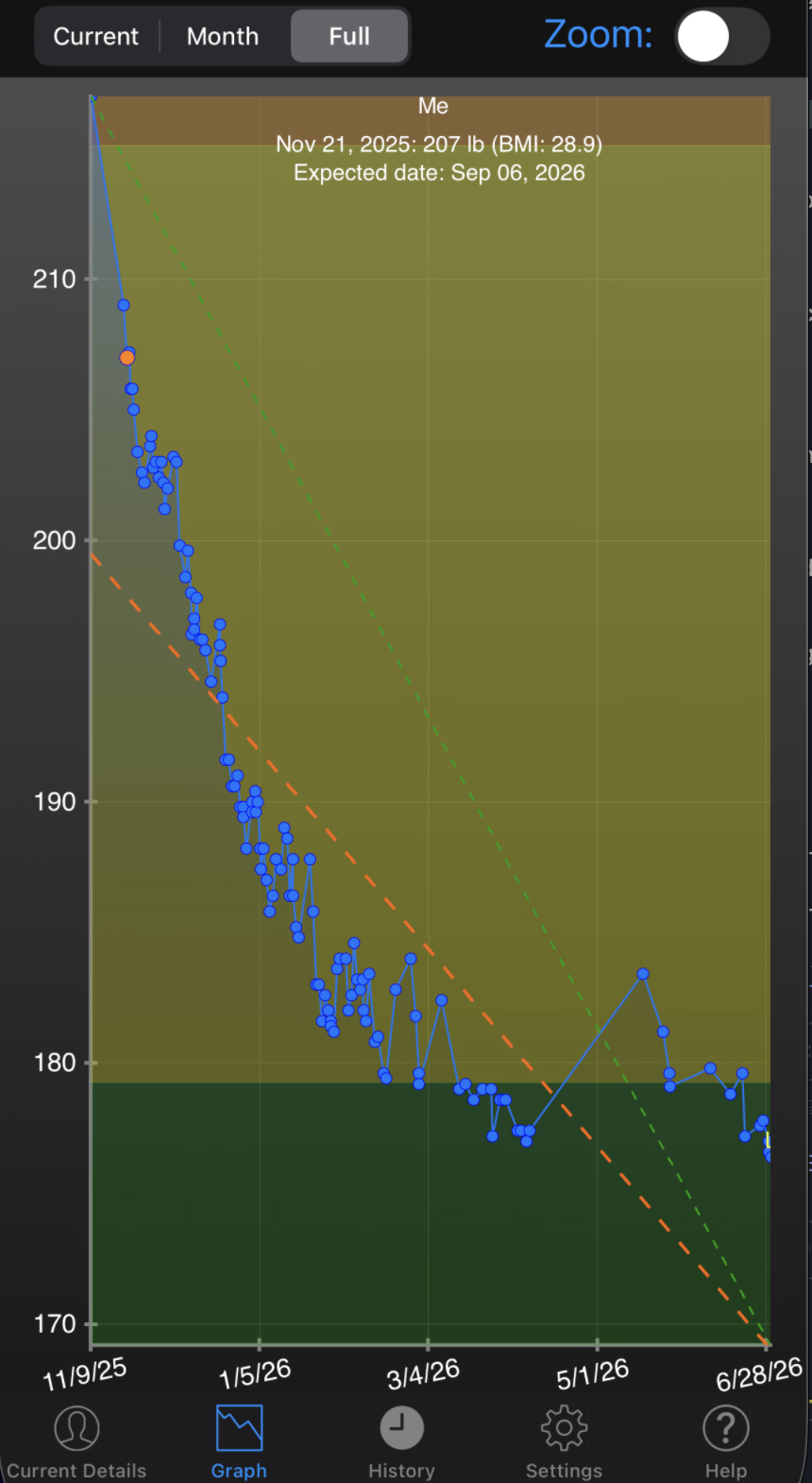
I started north of 210 — that's 207 pounds in late November, and it had only been climbing. Today I'm bouncing between 176 and 180, and the number I'm actually chasing is 169. Look at that line, though. The beginning was almost easy — it just fell off a cliff. Then it got jittery, fluctuated, flattened out around 180 for a good while. Now I'm into a second wave, finally breaking below 180 for real. It is not a smooth line. It's a sawtooth all the way down — the stalls, the week I spent in Canada with an ice cream sundae and a pile of other stupid things — but the direction never changed. (This is my third honest run at it, if you're wondering. Started November 2025. It's the summer of 2026 now.)
And here's something people don't clock about me: I'm a 60-year-old man. This is not a thing you had to start in your twenties — I sure didn't. You can start it at any point in your life, and it works. That's kind of the whole point. It's lazy, it's simple, and it does not care how old you are.
So there's your two stitches. One: the pain everyone quits over is salt and water, not carbs — put the salt back. Two: don't guess, measure — because if you don't measure it, it doesn't exist. Get those two right, and the thing everybody swears is impossible turns out to be, mostly, a shaker of salt, a finger-prick meter, and the patience to let a bumpy line keep heading down.